
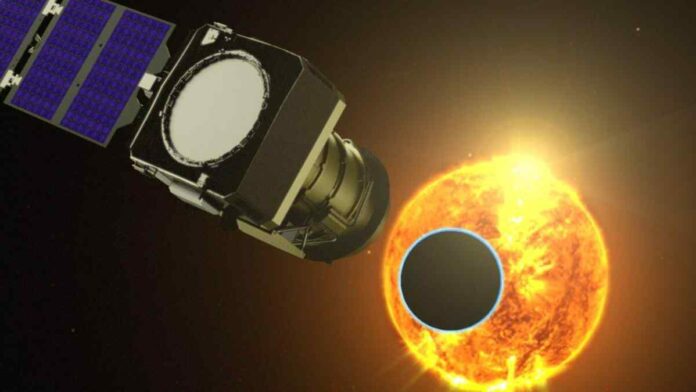


Remotely, far across this galaxy, planets may be circling and their atmospheres constructed with clouds hazes water and other chemical fingerprints. But how can we ever know?
We cannot put a probe on these worlds to analyze their samples but must infer from minuscule fluctuations in distant star light. This is precisely the sort of thing NASAs latest exoplanet mission Pandora will begin to do.
NASA officially announced the kick-off of Pandora’s scientific observations on 25 August 2026, after the successful end of its commissioning. The tiny satellite is going to spend on its main one-year mission to observe at least 20 exoplanets and their parent starsdata that will provide insight as to composition of these far-off bodies.
What is so interesting about Pandora is that detecting an exoplanets atmosphere is very difficult.
When a planet transits the star from our perspective, the light from the star that makes its way to our telescopes has passed through the planet’s atmosphere on the way. Molecules within this atmosphere can impart chemical signatures into this light. Scientists could use these fingerprints to look for material such as water.
Yet the major flaw here is that stars are not perfectly uniform themselves. Just as our Sun has darker and lighter regions ( sunspots and faculae respectively), distant stars can also display such features.
Time-dependent changes in these regions would generate signals that could be confused for, or diminish or distort the signatures from the planet’s atmosphere that researchers are trying to discover; in this case, a star’s signal could be partially or completely misinterpreted as a planet’s.
Pandora was built to solve that problem. The mission views planets and stars at the same time in the visible and near-infrared. By viewing each system for many hours and in many different wavelengths, we can distinguish what is the star from what is the planet.
NASA will observe each target several times during long 24 hour stretches during which data will be accumulated while the planet transits. Pandora will revisit its targets repeatedly during the mission providing a much richer set of information about stellar and planet evolution. We’re not only interested in finding new planets, says Jason.
Pandora is targeting worlds we’ve already detected and learning more about their atmospheres. The team at NASA explain that the purpose of this mission is to look for hazes, clouds and water, that might lend clues about physical conditions on those distant planets. Water is a vital ingredient.
Water by itself is not an indication of a planet being “life-friendly, ” but locating such potential is part of the process of environmental investigations. Pandora will allow for the collection of more accurate atmospheric data, as the hunt for life-supporting planets grows ever more precise.
The mission might also provide important supportive capabilities for a wider and more formidable suite of observatories including the James Webb Telescope.