
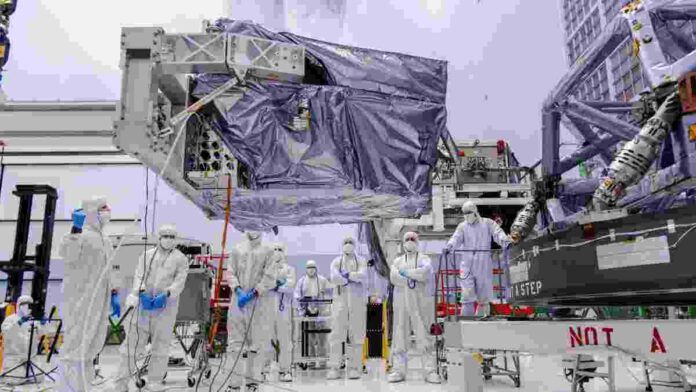


NASA’s Roman Space Telescope is slowly getting closer to a great feat: direct imaging of planets that are far away and are orbiting around stars. To make that happen, a special set of morphing mirror are designed to block starlight’s intense glare, enabling dim planets to be revealed next to them. Currently, these engineers are putting together and checking these adaptive optics systems as this mission is approaching its launch.
Many astronomers have been identifying the existence of a lot of exoplanets for a longtime via indirect methods observing the slight stellar wobbles or the slight dip in starlight caused by a planet crossing over its host. While these methods have been quite effective, researchers keep being left yearning for more. Direct images could help investigate atmospheres, climates and possible chemical indicators of these planets that are quite remote and that today, scientists can scarcely obtain such information. Still, one problem has remained as the brightness issue is that a star can be 1000 million times brighter than its planets thereby the light coming from planets is being drowned, even before it reaches the telescope.
Fundamentally to solve that issue, the coronagraph instrument of Roman Telescope is working with an active system of flexible mirrors. These mirrors change their shape slightly to neutralise distortions while at the same time block out starlight very precisely. The system does the dark space artificially thereby, the much weaker light from orbiting planets can be spotted. In fact, it needs a lot of delicacy and precision. It only takes a few milligrams of vibration or even small temperature change to disrupt the whole system which is a reason the hardware gets a full set of tests on the ground before its launch.
The real excitement in this technological development is that, the technology will, for instance, enable the detection of exoplanettes that, unlike the first generation planets that were mostly gas giants, would be the size of Neptune or smaller. The farther and weaker a planet is, the less chance scientists would have that it would emit the necessary light.
Apart from scientific and engineering achievements, there is also a human aspect, which is perhaps easier to skip when reading about the engineering parts. A whole group of scientists and engineers has been working for quite a long time on the polishing of these mirrors, the development of control algorithms and a series of tests that the equipment has to pass to be qualified to withstand the vacuum of outer space. Every positive test result gives them a subtle sense of accomplishment. For lots of researchers, that project is the fulfillment of a dream: to look for a star at a far distance and to actually, see the planets that it is surrounded by, not just being able to tell them apart from a star using shadows and wobbling.
The mission of Roman Space Telescope will be that of a large sky survey tool as it can photograph large parts of the sky very quickly. It is planned to add the coronagraph to serve a special role as a very sharp tool in a general-purpose observatory. These together will enable the mission to produce statistical knowledge about a great number of planetary systems and the observations of specific worlds as well. This feature, a mixture of broad and deep science, has created a big interest in the whole astronomy society.