
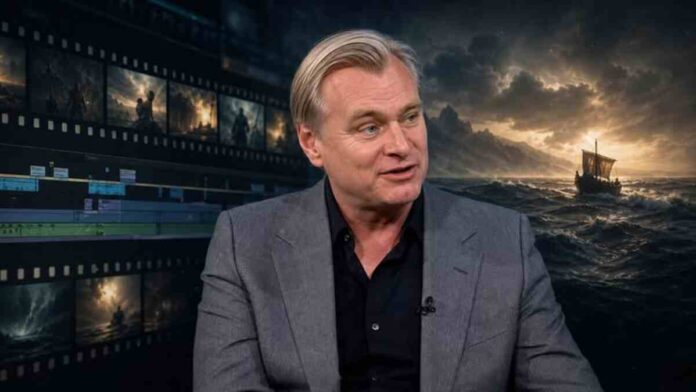


Renowned cineaste Christopher Nolan has redefined his creative thinking for The Odyssey and explained how traditional themes, faith-driven conceptions, and judgment have directed his current film. A recent interview with the Oscar-winning director reveals how painstaking it was for the filmmaker to interpret one of the most influential books that ever existed, filmizing some everlasting notions.
Famous for his works including The Dark Knight trilogy Inception Interstellar, Dunkirk and Oppenheimer, Nolan has established a reputation by creating broad, epic stories usually centered around profound philosophical concepts.
Now, with The Odyssey he turns to Homer’s epic, a tale that has influenced writers, artists and filmmakers for almost three thousand years. When asked about the controversial reception of the film, Nolan admitted that any big project attracts its share of critics as well as admirers. To him, criticism is not a thing to be avoided.
It is part of the filmmaking process and subject to which meaningful discussion of cinema can evolve. In the filmmaker’s own words: Nolan pointed out that the adaption of The Odyssey is not just copying mythology but how mythology raises questions that people still ask. As long as people believe in the myth, himself inclusion, the themes in the The Odyssey will resonate with us. Perseverance sacrifice redemption, loyalty temptation forgiveness purpose not others the others will still find them familiar and appealing. The director also mentioned the spiritual and ethical elements present in the epic.
As The Odyssey relates to ancient Greek mythology, Nolan pointed out that many of the core themes resonate with those in religious and philosophical teachings, such as those commonly linked to Christianity. Ideas like, “Hope in the face of adversity, ” “Belief when everything seems hopeless, ” “change and growth within oneself, ” and, “compassion and salvation, ” are powerful concepts, which are relevant to all.
He explained that he was not trying to make ‘a religious film’, but simply set out to find the ‘common human experiences’ which had made classic stories so important since the times of ancient literature.
His stories had universal appeal because they touched on fundamental feelings and ethical conflicts to which people of all beliefs could relate. Onto the physical journey of Odysseus, The Odyssey also traces the internal journey of Odysseus himself.
Immersing himself back in the physical world after venturing to the deepest corners of hell, Nolan believes that Odysseus’ inner journey ‘keeps the Homeric adventure alive’. 9. Nolan was also asked about the responsibility to adapt classic and loved stories for a modern audience. Nolan agreed that the source material needs to be treated with respect but the final product still needs to feel “new and emotionally engaging.” His past work has always tried to follow this philosophy.